
Is Your Children's Book Illustrator Real or AI?

12 tough questions to ask before you pay... and a No-AI contract, because I'm tired of writing condolence emails.
An author wrote to me recently.
She had done everything the way you're supposed to. Found an illustrator. Agreed on a price. Paid. And then she waited, the way authors wait, checking her inbox a little too often, imagining her characters finally having faces.
What arrived were AI-generated images.
Her money - gone. Her months - gone. And then the part that undid me a little: she found out afterwards that Amazon KDP requires you to disclose AI content, and that IngramSpark won't take it at all. The book she had already told her family about... suddenly had nowhere to go.
I read her email three times. I wanted to write back something useful and instead I just sat there, honestly, a bit heartbroken. Because I knew she wasn't the first. I know she won't be the last. This is happening quietly, all over the world, mostly to first-time authors the very people who walk into this industry with the most hope in their hands.
So no gentle blog post today. Today I'm going to ask you some hard questions. Please answer them honestly... especially the ones that make you shift in your seat.
First - three questions for you. Yes, you.
Question 1: If a full picture book usually costs $3,500 and up... why is your quote $300?
Sit with that one. Don't scroll past it.
A picture book takes a professional illustrator three to six months of real, daily work. Three hundred dollars for half a year of a human's labour isn't a bargain. It's a confession. (I've written honestly about what fair pricing looks like [here] - please read it before you believe another quote.)
Question 2: Could you tell AI art from human art right now, today, with your money on the line?
Be truthful. Most first-time authors can't. And I'm not saying that unkindly sometimes it takes me a second look, and I've spent years training my eye. The people running this scam know exactly how wide that gap is. Their whole business lives inside it.
Question 3: If your illustrator turns out to be typing prompts instead of drawing... who pays for that?
Not them. You. Your savings, your timeline, your KDP disclosure problem, your rejected IngramSpark upload, your name on the cover of something you didn't know was hollow. They keep the fee and dissolve into a new username by morning.
Unless and this is where I'm taking you you made them sign something first.
And one more thing. The one nobody warns you about.
Stop and think, for a moment, about how an AI "illustrator" actually works.
To make the machine generate images of your story... they have to give the machine your story. Scene by scene. Character by character. Often by pasting your words your unpublished words straight into a prompt box owned by a company you've never heard of.
Your manuscript. Inside an AI platform. Before your book even exists in the world.
And here's the part that turns my stomach: many of these platforms reserve the right to keep what's typed into them some may use it to train the very models that were already built on stolen art. Your characters. Their names. The little world you built at your kitchen table over two years of early mornings. Fed into the machine by someone you paid to protect it.
You cannot unfeed it. There is no getting it back out.
So understand what's truly at stake here. This was never only about the pictures. When you hand your manuscript to someone who works with AI, you're not just risking bad art you're handing your unpublished story to their tools, and their tools don't sign NDAs.
(Yes the contract at the end of this post covers this too. Your illustrator warrants that your manuscript never touches an AI platform. Not for "inspiration," not for prompts, not at all.)
Now, nine tough questions for your illustrator
Ask these before any money moves. Here's the thing that should comfort you: a real illustrator answers all nine easily. Most of us will quietly love you for asking, because every author who asks these questions makes the ground a little firmer under all of us.
Watch what happens when the answers go slippery instead.
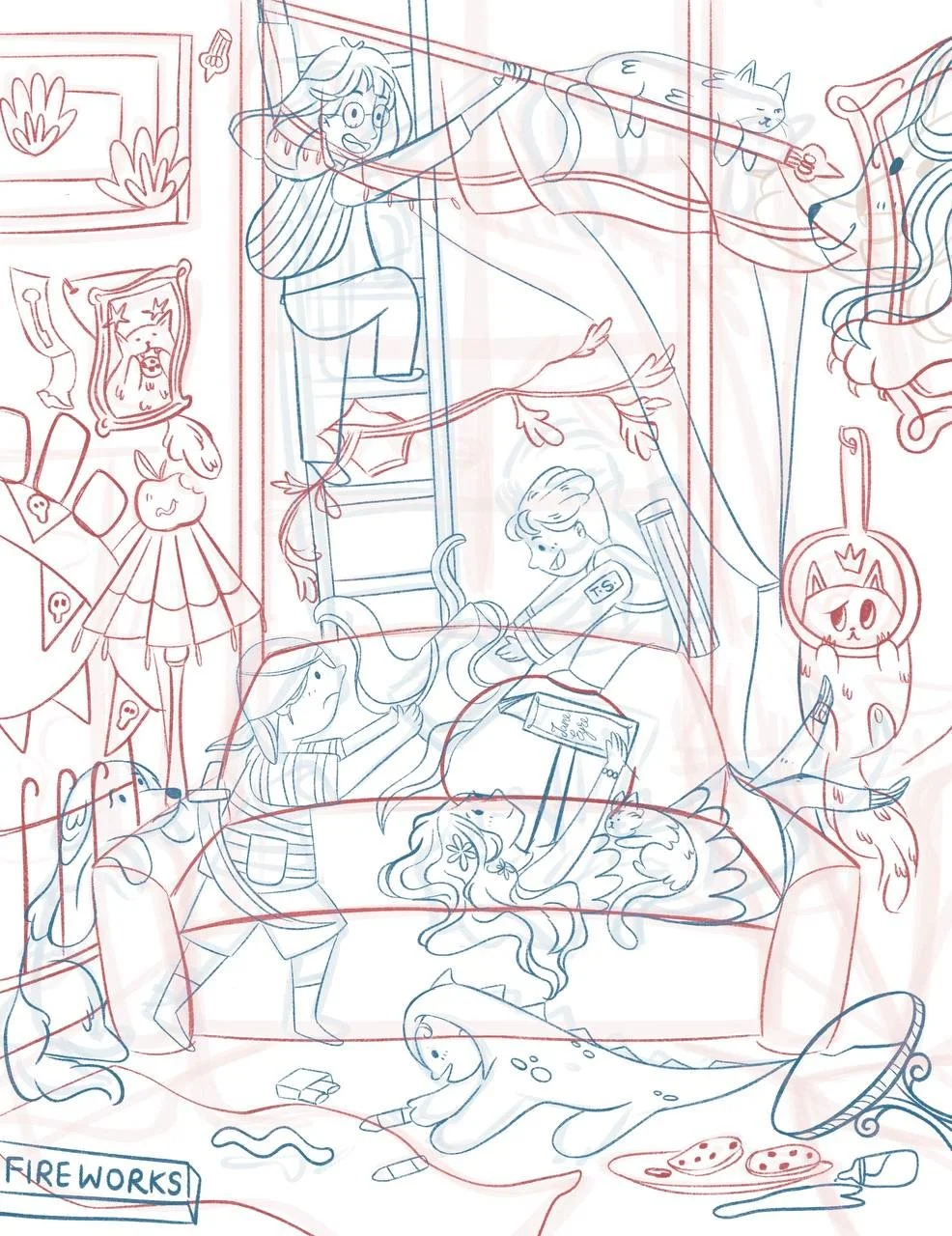
Question 4: "Can I see your rough sketches and thumbnails as we go?"
A real illustrator: "Of course sketch approval is a stage in my process." Thumbnails, roughs, line art, colour... that's simply how a book gets made. A prompt can fake a finished image. It cannot fake the ugly middle.
A scammer: "I only share final work." Walk away.
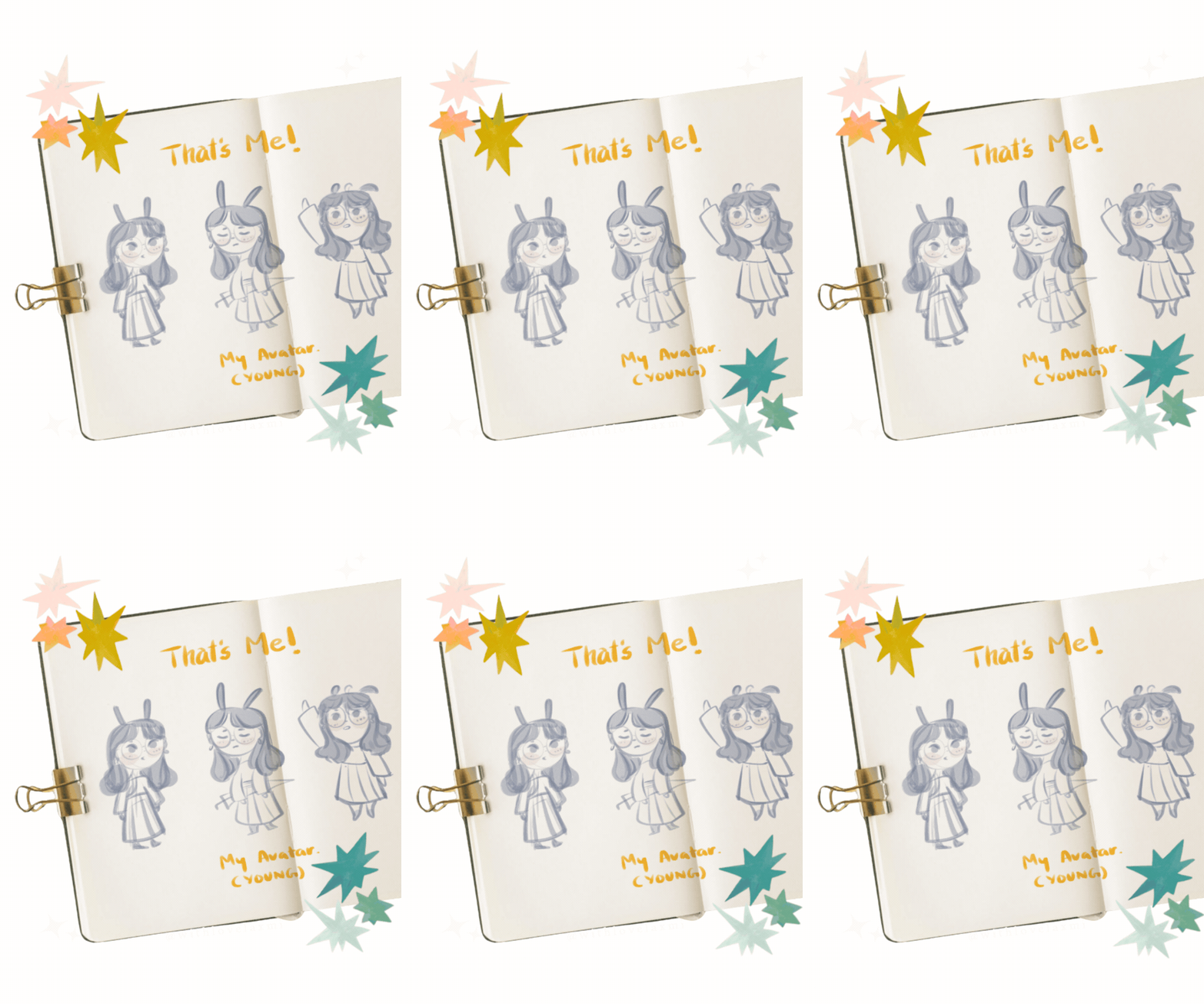
Question 5: "Before we start, can you draw my main character in three poses and three expressions?"
For a real artist, this is a warm-up. Genuinely it's the fun part. For AI, consistency is still where the mask slips: the face drifts, the hair rewrites itself, the child on page 4 is not quite the child on page 12. One small test. It filters out almost everyone you need filtered.
Question 6: "What do you work in and would you show me a time-lapse?"
Procreate records a time-lapse of every artwork automatically. Photoshop files hold their layers like tree rings. AI images arrive flat... no layers, no history, no past. You don't need to keep any of these files. You just need to know they exist.
Question 7: "Where was your portfolio in 2021?"
Strange question? It's my favourite one. Real illustrators have history a style you can watch slowly growing up, old sketchbooks, client work from before image generators existed. A portfolio that appeared last spring, fully formed, glossy, with characters that don't quite match each other...? Ask more questions. Or don't. You already know.
Question 8: "Can we do milestone payments tied to sketch approvals?"
Real illustrators work this way anyway deposit, sketches, line art, final. Someone demanding everything upfront, before you've seen a single rough, is asking you to hold all the risk while they hold all the money. No.
Question 9: "Do you use AI at any stage of your work? Any stage at all?"
Ask it exactly like that, and then listen for one particular word: "assisted."
"AI-assisted." "Just for backgrounds." "Only for ideas." That word is where honesty goes to blur, one convenient inch at a time and I need you to understand why I've stopped allowing it any inches at all. Those image models were trained on millions of artworks scraped from living, working artists. Copyrighted work. Taken without consent, without credit, without a single coin of payment. Every AI image carries that theft inside it, the way a stolen ring is still stolen no matter how prettily it's worn.
There is no "small" amount of that in a children's book. In my studio, no AI means no AI.
Question 10: "Who owns the copyright, what rights am I actually buying?"
A professional has a clear answer and a written contract already waiting. (I've walked through what that contract should include {Download Here} I'll tell you something I've noticed over the years: vagueness about rights and vagueness about AI tend to live in the same house.
Question 11: "Will you put all of this in writing?"
Everything above is worth nothing as a conversation. It is worth everything as a signature.
Question 12: the only one that truly matters: "Will you sign a No-AI warranty?"
One question. The whole test.
And before I hand it to you... I need to tell you about the other half of this grief.
The part that hurts to write
This scam wounds twice, and hardly anyone talks about the second wound.
The author loses her money. That's the first one. The second happens slower: somewhere along the way, "made on a computer" and "made by a computer" began to blur into one suspicious smudge and honest digital illustrators, all over the world, are being made to answer for a theft they didn't commit.
Let me tell you what's happening to artists like me, all over the world.
Digital illustrators people who spent years learning to see, to draw, to build a style line by line are being accused of using AI. Without evidence. Sometimes without even a conversation. A finished piece looks "too polished," "too clean," "too much like what the machines make"... and suddenly a decade of practice is on trial.
Artists have been banned from art communities for work they made with their own hands. Portfolios offered as proof, and dismissed. Because once suspicion arrives, no amount of truth seems to matter.
And it goes deeper than accusations. I've read of artists quietly abandoning the very styles they spent years developing reshaping their own artistic voice just to look "less like AI." Imagine that for a moment. Real artists, contorting themselves to prove a machine didn't make them.
And the people actually using AI? They simply lie. Their dishonesty is the exact reason authors have stopped trusting artists like me.
I'm a digital illustrator. When I work in Procreate, every line is drawn by my hand ten thousand small decisions about where the light should fall, about how a child's shoulders sink when she is sad. A stylus instead of a sable brush. That is the entire difference. I spent years earning these hands. So yes... being asked to prove I'm human stings. I won't pretend otherwise. Some days it feels like grieving something the days when this work was simply believed.
But here is where I've landed, and I mean it: I would rather prove it a hundred times over than read one more email like hers. Scrutiny only frightens the people who can't survive it. I can. Every honest illustrator can.
So: choose illustrators who are real. Not "digital versus traditional" that was never the line, and please don't let anyone redraw it there. Real versus generated. Hands versus prompts. A history versus a username created last spring. Every question in this post is one a genuine artist passes while barely looking up from the drawing board.
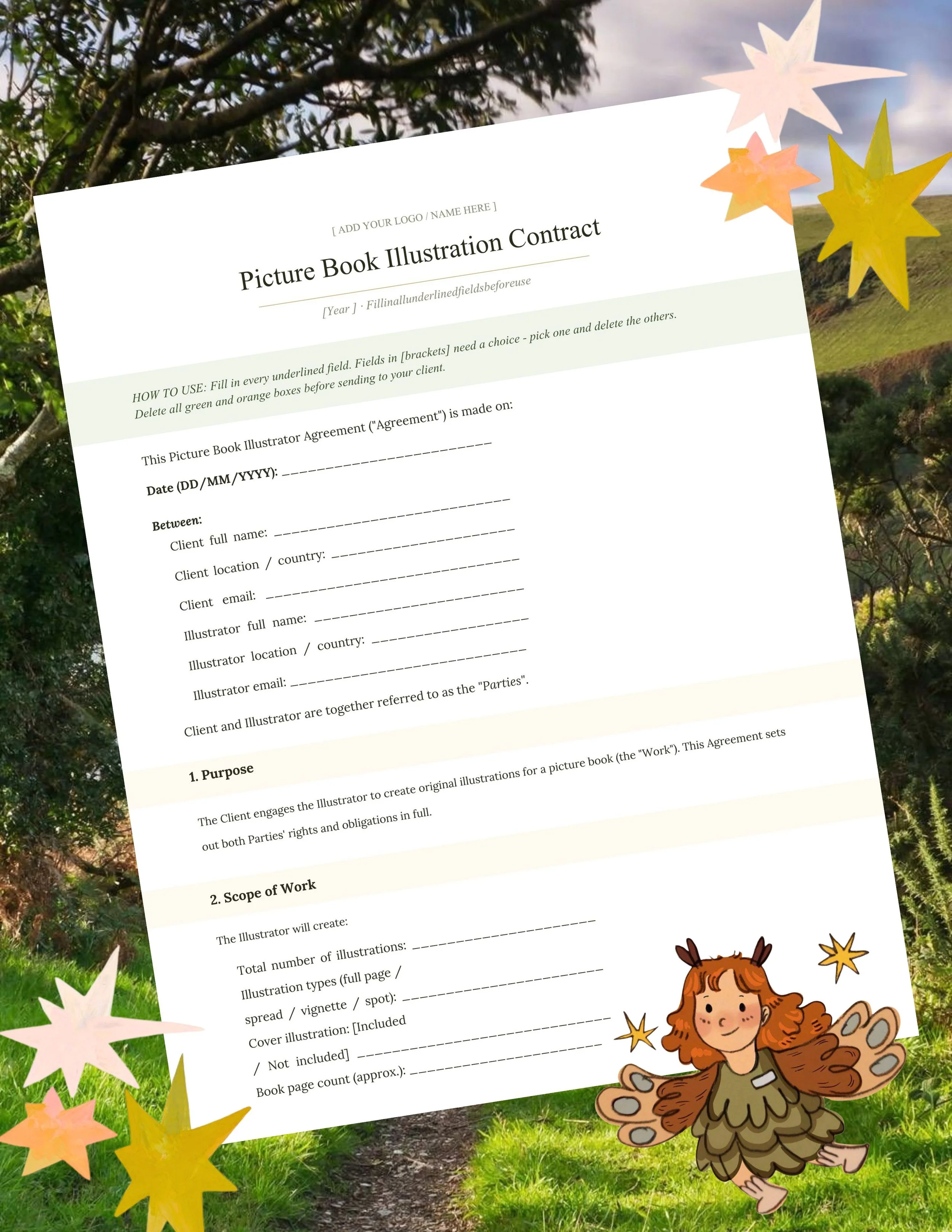
The No-AI (Mandatory) Contract - yours, free
I've turned everything above into a one-page addendum you can attach to any illustration agreement. Your illustrator signs to warrant that:
the artwork is original and human-created no AI at any stage, in any proportion;
your manuscript never touches an AI platform they will not paste, upload, or feed your story, your characters, or any of your materials into any AI tool, for any reason;
it infringes no one's copyright it never touched a model trained on stolen work;
they'll name their tools and show sketches, layers, or time-lapses whenever you ask;
and if any of that turns out to be false, they carry the cost full refund, plus the platform mess not you.
A hand-drawn illustrator, digital or traditional, anywhere in the world, can sign this in thirty seconds... because it simply describes what we already do. I sign it on every project. Mine is usually the first signature on the page.
So here is your rule. It has no exceptions, and I'm not going to soften it:
If an illustrator refuses to sign the No-AI warranty- do not work with them.
Not "let me think about it." Not "we can adjust the wording." There is no honest reason on this earth to refuse to promise that a human made the art you are paying human prices for. A hesitation is the answer.
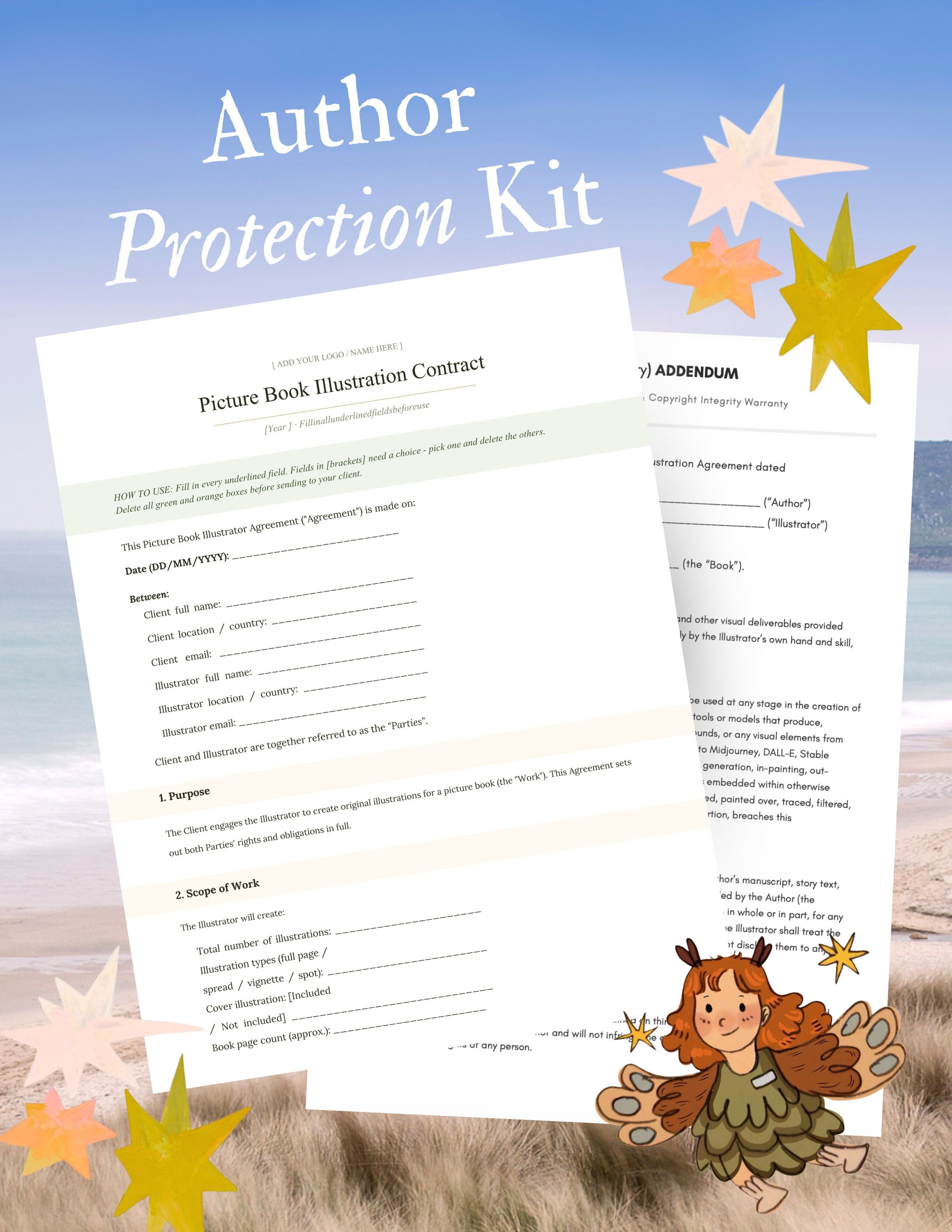
(One small honest note: I'm an illustrator, not a lawyer. This addendum is a strong start — for bigger projects, do have a legal professional glance over it for your part of the world.)
One last question. This one's for me.
“Laxmi... do you pass your own test?"
Every author I work with gets my thumbnails and rough sketches at every milestone. My Procreate time-lapses, if they'd like them. My signature on that addendum before I ever ask for theirs. The wobbly first drafts, the messy middles truthfully, that's the part of this work I love the most. It's the part where the book is still becoming.
If you've written a story, and you want to be certain that a human heart draws it say hello. Tell me about your book. I'll answer all twelve questions before you've even asked.
And soon, I'll be writing the companion to this post: where to actually find real illustrators honest recommendations, including artists who aren't me. Because protecting this little corner of the world was never meant to be a one-person job.
Related reading:
Letters from the Sketchbook